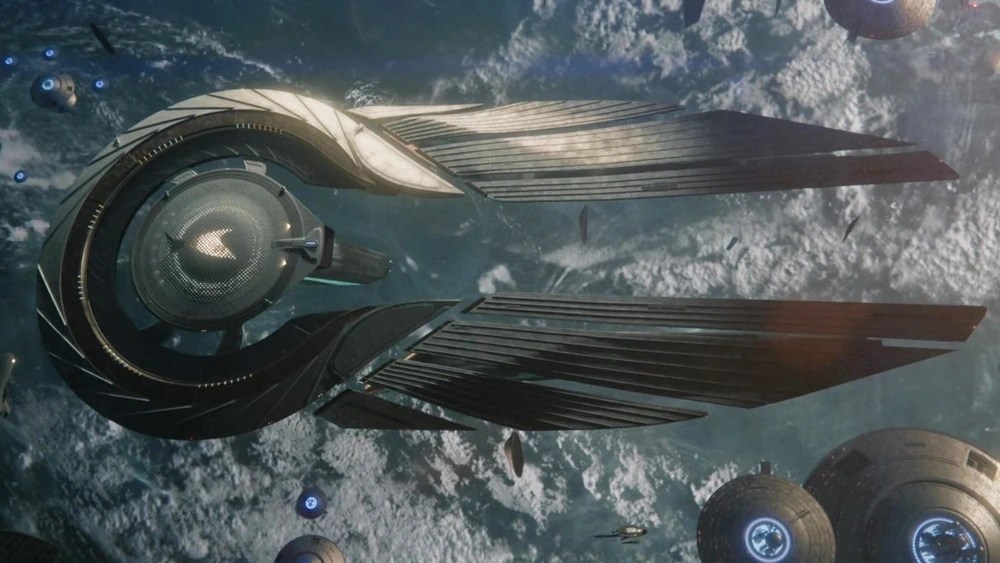
To quote the version of James T. Kirk from my least favourite iteration of Star Trek, “Buckle up.”
There are apparently a lot of people who don’t like what is sometimes pejoratively, and stupidly, referred to as “Nu Trek” in general and Starfleet Academy in particular. Which is fine. No one is the target audience for everything, and if you come across a show you don’t like, there’s ample opportunity and sourcing for things you do.
Based on the general complaints curdling across every corner of the internet where such things are discussed, there are very, very few people who dislike the show because of the writing or the acting or anything beyond the basic casting. Instead, they complain about it being “too woke”, whatever that means, or too political, or, in the case of the ones who want to seem a little smarter, too obviously commenting on current societal issues in ways that don’t match up with the opinions or “sincerely held beliefs” of the complainer of the moment. These have been pretty standard complaints in the language of the time for every single series that’s ever been produced, including the original one.
Remember I said to buckle up? Make sure you’re securely strapped in by the end of this paragraph. I have normally, as is my preference, either ignored this whining commentary or have politely tried to redirect it when it intrudes on a conversation I’m already having. Sometimes, I’m forced to be a little more direct with a laugh emoji or a more pointed observation of “keep crying”. That’s all over now, and I have a simple message that will probably offend some of them and go over the heads of most of the rest because I’m clearly a triggered lib (neither, but a discussion for another time). To address the haters complaining about “Woke Trek” directly:
Stop your incessant whining and pry what’s left of your minds open, you spoiled, gatekeeping little shitbags. You’ve entirely missed the point of Science Fiction in general and Star Trek in particular.
To be clear, the point of SF isn’t really to tell stories of about things happening in some hypothetical future or on some hypothetical other world with aliens and space ships and guns that go pew-pew. Those are byproducts and while they can produce some fun stuff to read/watch/listen to, inside every one of those apparently just-for-fun stories there is an idea. It might be a small one, maybe even small enough to pass by unnoticed to most folks, but it’s there. And if we’re honest, there’s usually more than one, but any SF story needs at least one idea. That idea is a simple what if. What if somebody invented this crazy thing? What if this social idea/practice/movement were taken to a logical conclusion or extreme? What if current events continue on in some particular way? What if our current societal conditions shift or contract or expand in a certain manner? What if this very unlikely thing happens? What if?
Science Fiction holds a mirror up against reality and then puts one or more ripples or waves into the reflection to see what we can learn about ourselves and the universe around us.
The point of Star Trek is almost the same, it just takes it a step further by asking two more questions. What does it mean to be human? How can that definition be expanded? It also sometimes makes statements that can feel cliché if you make them outright. We should be who we say we are and work towards being who we want to be.
It was a throw away moment late in the third season of TOS because Gene Roddenberry wanted an extra marketing opportunity, but it put the underlying base of Star Trek into a Vulcan motto that came into English as IDIC. Infinite Diversity in Infinite Combinations. But you can find the concept going far back in the first series, not just in late in the last season with “Is There No Truth In Beauty” where it was introduced, or “Let That Be Your Last Battlefield” where we got our faces rubbed in how stupid a concept racism is from the moment we found out there two aliens involved. Examples of the top of my head, rearranged into inverse production order (I almost always favour production order over broadcast order):
- “Journey to Babel” (S02E15) – the whole structure of the Federation is built as a coalition between different species, some of whom looked very different by the makeup technology of the time, and certainly expressed different attributes.
- “The Doomsday Machine” (S02E06) – “We’re stronger with you than without you.”
- “Errand of Mercy” (S01E27) – even though the crew had their noses rubbed in it, the difference and autonomy of the Organians, a non-corporeal life form, was something to be respected.
- “The Devil in the Dark” (S01E26) – we figure out that the Horta isn’t a monster but sapient and just trying to protect the future of its species.
- “Balance of Terror” (S01E09) – “Leave any bigotry in your quarters. There’s no room for it on the bridge.”
- “The Corbomite Maneuver” (S01E03) – communication is chosen over violence. Let’s work things out.
- “The Man Trap” (S01E06) – the very first broadcast episode, the first episode of Star Trek the wider world got to look at, usually dismissed as a creature feature, ends on a tragic note that they’d been forced into killing a creature that was the last of its species and simply trying to survive its own biological imperatives.
- “Where No Man Has Gone Before” (S01E01) – The first episode in production order. Not just because Mitchell is Kirk’s friend, but Kirk and crew try desperately to understand the transformed officer before seeing him as a threat, even ignoring inarguable logic offered by Spock while they do it.
- “The Cage” (S01E00) – the original pilot, filmed a year before the Kirk-Spock-McCoy edition and rejected as “too cerebral” by network executives, had a resolution based on working towards an understanding the other.
We can trace these threads through every series and in many (probably most) of the episodes of every season. Work to understand the unknown. Reject prejudice and hatred. Cooperate. Communicate. See diversity as strength. IDIC.
It’s a hard message to miss, so I don’t understand how some people seem to.
The good news is that the haters can get better. Another of the lessons of Star Trek is that one of the wonderful things about being human is possessing the ability to examine our beliefs and opinions, hold them up against reality and decide if they need to change.
But I’m willing to bet most of the folks who need to think about their reaction to the show or the current Star Trek era probably won’t because then they’d have to confront the fact that what they’re really mad about is that 90% of the cast doesn’t look and sound like them. But why should it? It’s not like 90% of the world looks and sounds like them, and every incarnation of Star Trek so far presents a setting that’s far, far broader than just one world. The “Nu Trek” haters who are hanging themselves out for the world to see as bigots have by now, I hope, started to recognize that if they’re going to bitch openly, they should expect to get slapped down openly. We see the racists that they are and the world desperately needs them to outgrow it. Star Trek repeatedly dealt with racism specifically and bigotry in any form in its first incarnation, and it never did so without a blunt instrument. Bonk, bonk on the head. It’s continued on right into the current incarnations, sometimes subtly like with casting and character choices, and sometimes with stories that deliberately punch us in the face.
IDIC.
Now, if you’ve persevered this far, you absolutely deserve to know what I think of Starfleet Academy. It’s probably obvious, but let’s be certain.
I love it.
The show is telling fun stories that stretch boundaries and show us that working towards a future that works for everyone is possible even when recovering from a disaster that tried to tear the fabric of society apart, in this case one spanning hundreds of light years.
Live long and prosper.
And be well, everyone.




 Life, Writing, Weirdness
Leave a comment