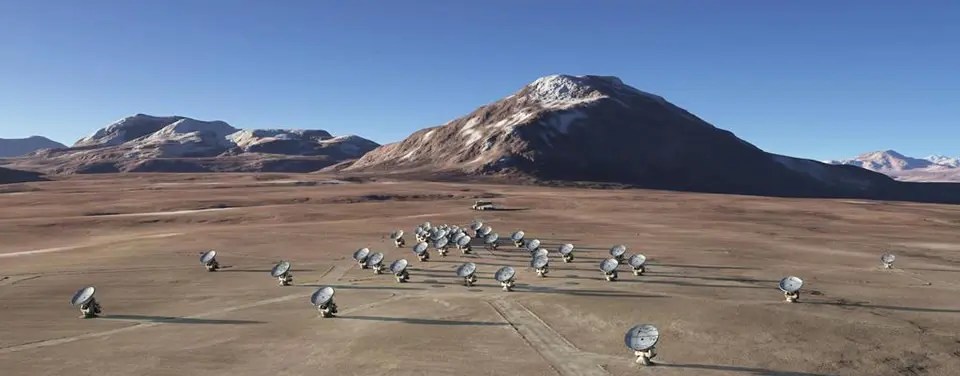
ALMA, the Atacama Large Millimeter/submillimeter Array is located on the Chajnantor Plateau in the Atacama Desert of Chile. It’s made up of 66 high-precision antennas which operate on wavelengths of 0.32 to 3.6 mm (hence the Millimeter/submillimeter designation.
It’s a serious marvel of scientific engineering, essentially running 24-hours a day, 365 days a year to gather information in those wavelengths on objects scattered across the night sky.
And, as of today, it’s been gathering that information for thirteen years.
Okay, that’s not exactly true. Today is the 13th anniversary of its official inauguration, although the earliest science projects had been going on for almost a year and a half at that point. “First Light” as the initial operation of a big observatory is usually designated, was on 30 September 2011 using 16 of the intended 66 antennas. That’s more properly ALMA’s birthday and we’ll certainly celebrate it at the appropriate time. But as of inauguration, 57 out of 66 of the antennas were operational, bringing it to effective (if not quite complete) full capacity, so that’s what I’m marking with this post.
Why should you care?
Because it’s cool. It might only be a passing footnote for most of the people who read this, something forgotten before many minutes have passed, but the scope of ALMA’s physical footprint (at maximum, a rough circle 16 km in diameter, or around 200 square kilometres), not to mention the data it can gather, is very cool.
Why do I care enough to want you to care, even if only for as long as it takes to read this?
That’s a much bigger question, really.
I went back to higher education at age 50, and I’ve discussed the path I got myself onto before. That path contained an undergraduate thesis that developed a process to use a little bit of historical ALMA data. My Master’s project takes that basic concept and runs with it.
I’m using data previously gathered by ALMA on what are called Young Stellar Objects, YSOs for short, which are objects that will someday be stars but haven’t started fusion in their cores yet. I’m pulling data that was originally used for surveys of size, mass, presence, or looking at other things entirely, looking for signs of substructure. More specifically, I’m looking at the youngest YSOs, the ones still in the clouds they formed in, and the substructure I’m looking for amounts to circles and ellipses. Rings and gaps. The ultimate objective is to try to get a better idea of when planets start to form. I’m still gathering data and have started more detailed analysis in the background, but without putting any numbers to things, planets start to form, or the processes start that may eventually mean planets form, pretty early in the lifespan of the star that isn’t a star yet.
And that’s very cool.
Be well, everyone.





 Life, Writing, Weirdness
Leave a comment