First Spaceship on Venus is a Cold War science fiction movie produced on the other side of the Iron Curtain, an East German/Polish movie originally released in 1960 as The Silent Star and based on the 1951 novel of The Astronauts by Stanislaw Lem. Lem is an author that’s well known to SF readers of a certain age, one of the first authors to break through the curtain and have his translated SF published in the west.
The movie has much to recommend it, but also some substantial problems.
First, the good.
It had an almost shockingly diverse cast. Remember that it’s 1960. The crew of the Kosmoskrater is international in a way that wouldn’t be accomplished for a made for western audiences movie or television show for probably twenty years or more. Probably much more because I’m struggling to come up with anything close in the 80s. At least half of the speaking roles, in spite of the time period and filming location, were clearly not white folks. There are two very notable examples.
First, the fellow who played the communications officer, Julius Ongewe, was apparently an African exchange student in medical school – this is his only acting credit and he may never have known that he was breaking barriers in cinema. And second, Yoko Tani was a French-born actress of Japanese descent who had a lot of film credits in the 1950s and 60s and seems to have gotten top billing a lot of the time for this film (she’s also first in the credits).
The Cold War itself is never mentioned but the movie takes place in 1985 and the inclusion of people from nationalities on both sides of the cold war seems to lean towards the idea of a successful and mutual conclusion to it.
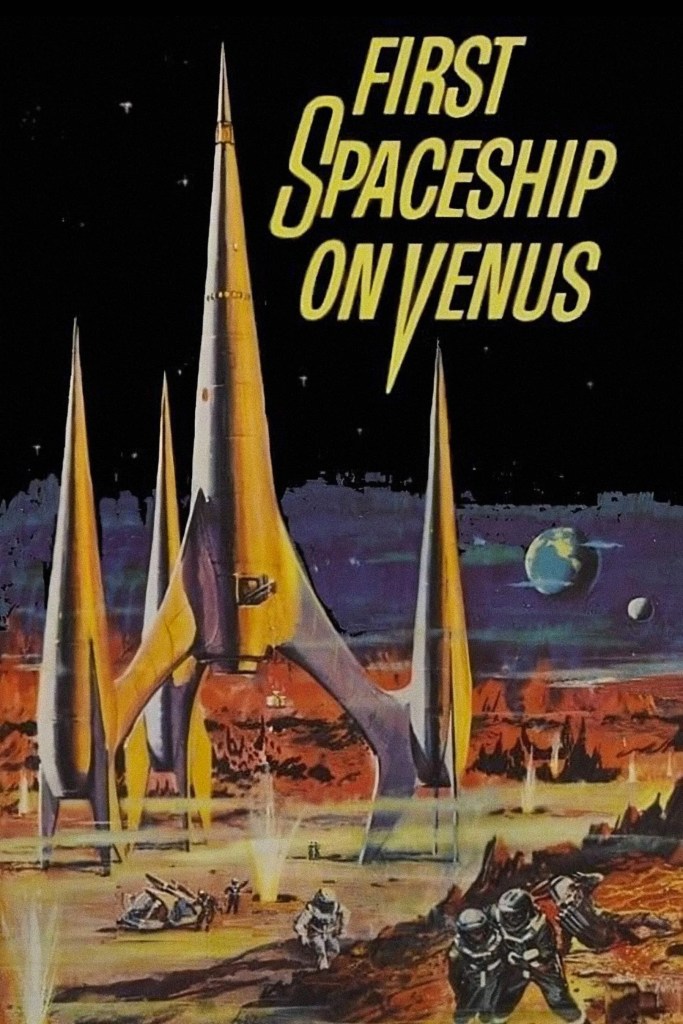
And the film aesthetic is gorgeous. There are a lot of what we’d now call retro-future visuals – sleek surfaces and blinking lights, smooth camera shots and bright colours. The spiky silver spaceship is left over from Golden Age SF and beautiful to look at.
The not so good:
So much exposition! It seemed like the first ten minutes of the movie was almost exclusively a narrator explaining the global situation, space program, technology, and state of the solar system while the actors moved around in the background and someone occasionally spoke.
Lem’s story is there, but it’s not very well delivered by the script. Part of that might have been things getting lost in translation, but I’m not sure that I have to look farther than the fact that there are seven people involved in the adaptation to a screenplay.
And there’s not a lot in the way of actual acting. Recitations of lines, mainly, and it didn’t seem like there was a lot of direction. Actors talking at one another and not expressing much emotion most of the time. That wasn’t helped by a mediocre dub job with mostly emotionless voice actors.
And yet it was interesting to watch, which was, perhaps, helped by the 79-minute run time.
Ultimately, the plot seems to be a warning against nuclear war, personified by an extinct civilization, an alien doomsday weapon, and complete with a Hiroshima reference.
And again, the ship is gorgeous, something from the cover of a golden age SF magazine, sleek, sharp, burning a trio of rockets to push it across the heavens.
Worth the watch, though probably only once.
Be well, everyone.



Leave a Reply